From the devastating effects of Arizona's 2026 monsoon storms to deteriorating roads, drainage systems, roofs, and community amenities, deferred maintenance can create financial consequences that extend far beyond the original repair.
Arizona's climate is unforgiving on community infrastructure. Months of extreme heat, prolonged UV exposure, shifting soil conditions, and sudden monsoon storms place continuous pressure on the assets homeowners associations are responsible for maintaining. While many communities are designed with these environmental conditions in mind, even well-constructed infrastructure requires consistent inspections, preventive maintenance, and long-term financial planning.
For HOA Boards, the greatest financial threat is not always an unexpected disaster. Often, it begins with a maintenance concern that was identified but never fully addressed. A drainage channel accumulates debris, a roof develops minor deterioration, pavement cracking goes untreated, or irrigation equipment continues operating inefficiently. Individually, these issues may appear manageable. Over time, however, their combined financial impact can become substantial.
Deferred HOA maintenance is not simply a matter of postponing repairs. It is the accumulation of physical deterioration, operational exposure, and future financial obligations that can affect an entire community. When maintenance decisions are disconnected from HOA financial management, vendor oversight, and reserve planning, Boards may find themselves responding to expensive emergencies rather than managing predictable infrastructure needs.
For homeowners associations throughout Phoenix, Scottsdale, Chandler, Gilbert, Mesa, Peoria, Glendale, and surrounding Arizona communities, understanding these risks has become increasingly important. The severe weather events of 2026 provide a timely example of why proactive HOA management must extend beyond routine landscaping, service requests, and monthly financial reports.
The 2026 storm season brought renewed attention to the vulnerability of Arizona's developed communities. Intense rainfall, flash flooding, damaging winds, and severe thunderstorms affected portions of the Phoenix metropolitan area, demonstrating how quickly environmental conditions can disrupt roads, residential neighborhoods, drainage systems, and public infrastructure.
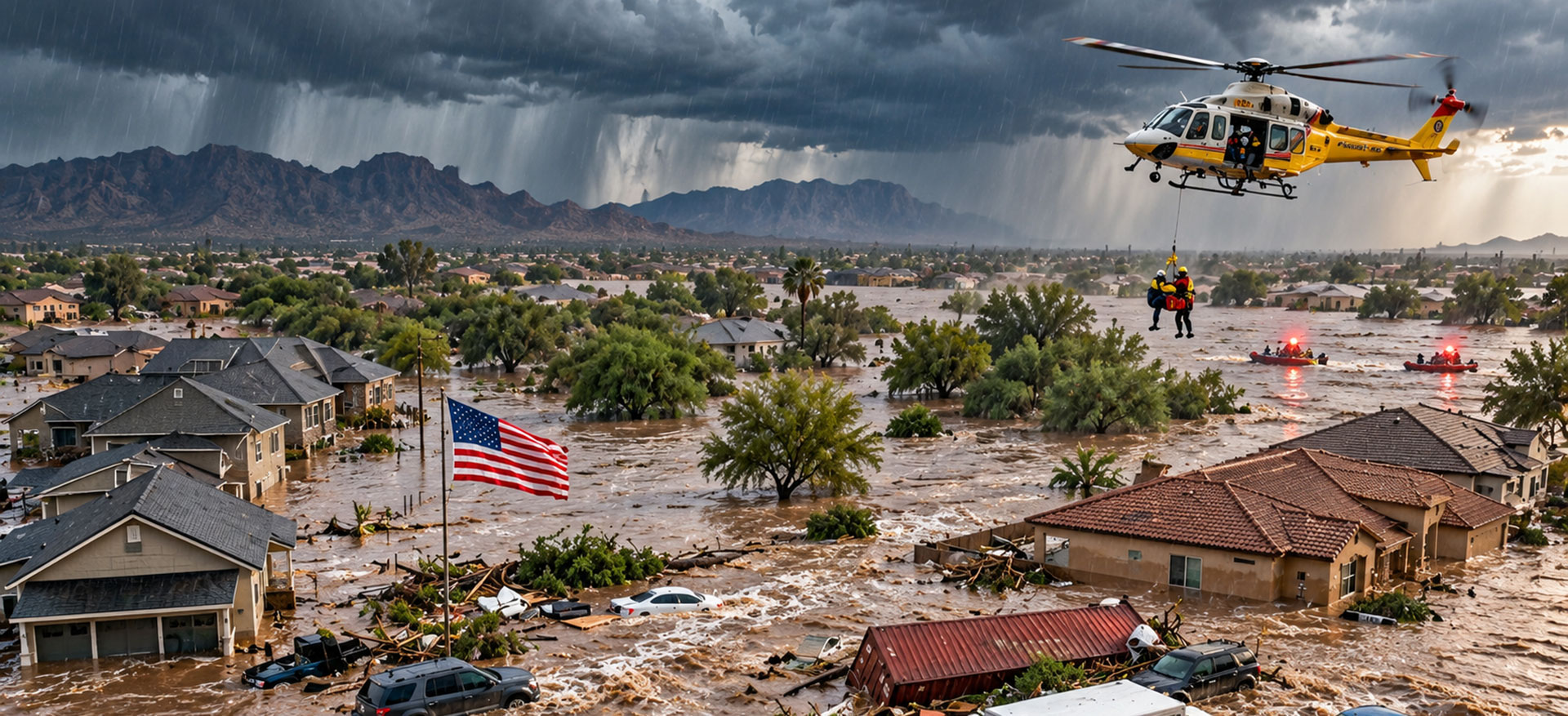
On September 16, 2026, powerful thunderstorms produced approximately two to four inches of rainfall within two to three hours in portions of northern Maricopa and northern Pinal Counties. Flooding affected streets, washes, and low-water crossings, while emergency responders conducted swift-water rescues. Incidents in North Scottsdale and North Phoenix highlighted the speed at which concentrated rainfall can create dangerous conditions, even in a region more commonly associated with prolonged dry weather.
The broader 2026 monsoon season also brought unusually significant rainfall to parts of Maricopa County, with September contributing heavily to seasonal precipitation totals. Although rainfall varied across the Valley, the storms demonstrated that communities cannot evaluate their infrastructure readiness solely by the amount of rain they typically receive. Storm intensity, drainage capacity, surrounding development, and the condition of existing infrastructure all influence how effectively runoff is managed.
For Arizona HOA Boards, these events raise questions that extend beyond immediate storm cleanup. Have retention basins been inspected for sediment accumulation? Are drainage channels clear of vegetation and debris? Has erosion developed around common-area walls, roadways, or landscaped slopes? Does the association maintain current records of stormwater infrastructure, and are qualified vendors available when emergency repairs become necessary?
Extreme weather can overwhelm even properly designed and maintained systems. However, HOA preventive maintenance can reduce avoidable vulnerabilities, identify developing infrastructure problems, and support more effective emergency response.
The weather-related challenges did not end with September's flooding. During October 20–22, 2026, severe thunderstorms brought large hail and damaging winds to portions of central and eastern Arizona. Storm activity affected Chandler, Mesa, and Phoenix, creating additional concerns involving roofs, trees, vehicles, and exterior structures.
On October 20, a severe thunderstorm moving through Chandler and Mesa produced hail approximately one to two inches in diameter and uprooted numerous trees. Reports documented extensive tree damage in a Chandler park, along with damage to vehicles, carports, and other property. The following day, another powerful storm affected central Phoenix, bringing hail around two inches in diameter and wind gusts exceeding 60 mph.
For HOA communities in Chandler, HOA communities in Mesa, and HOA communities in Phoenix, these events underscore the importance of evaluating more than drainage systems. Tree stability, roofing conditions, exterior building materials, landscape maintenance, and emergency vendor coordination all contribute to a community's ability to withstand severe weather.
The financial implications may continue long after visible storm debris has been removed. Roof damage may require professional inspections, compromised trees may create ongoing safety concerns, and storm-related deterioration can accelerate the replacement timeline for infrastructure that was already approaching the end of its useful life.
These events reinforce an important distinction: storm damage may be sudden, but the underlying condition of community assets develops over years. Boards that understand those conditions before severe weather occurs are better positioned to make informed decisions about repairs, insurance, and future capital needs.
Stormwater infrastructure is among the most consequential and frequently overlooked assets within an Arizona homeowners association. Retention basins, drainage channels, culverts, catch basins, and engineered grading systems help manage runoff and direct water away from vulnerable areas. Their effectiveness depends not only on their original design but also on consistent maintenance and the condition of surrounding infrastructure.
Arizona's extended dry periods can create a misleading impression that stormwater systems require little attention. During those periods, sediment, vegetation, debris, and erosion can gradually compromise drainage capacity without creating immediately visible problems. When intense rainfall arrives, the association may discover that water cannot move through the system as intended.
The September 2026 flooding demonstrated how quickly concentrated rainfall can overwhelm streets and drainage corridors. Although not every flooding event can be prevented through maintenance, neglected drainage infrastructure may increase the likelihood of avoidable property damage, erosion, and emergency repairs.
For master-planned communities, gated communities, and condominium associations, drainage oversight should include regular evaluations of retention basins, drainage inlets, culverts, common-area slopes, and locations where standing water has previously occurred. Boards should also understand whether stormwater infrastructure is maintained by the association, a municipality, another public agency, or a separate entity, since responsibility varies by location and governing documents.
A drainage inspection should accomplish more than confirming that an area appears clean. It should identify whether the system is functioning as designed, whether erosion is developing near structures, and whether additional engineering evaluation is warranted. Where recurring drainage deficiencies exist, qualified professionals should assess the underlying conditions rather than relying exclusively on repeated temporary repairs.
Arizona's intense sunlight, high temperatures, thermal expansion, and seasonal storms create demanding conditions for roofs, exterior coatings, flashing, sealants, and other building materials. These environmental factors can gradually reduce the effectiveness of protective systems, particularly when inspections and scheduled maintenance are postponed.
A minor roofing deficiency may remain unnoticed during extended dry weather. However, once heavy rainfall or wind-driven storms arrive, deteriorated flashing, compromised sealants, or damaged roofing materials can allow moisture to penetrate the building envelope. What initially required a relatively limited repair may develop into extensive restoration involving insulation, ceilings, electrical components, or interior finishes.
This concern is particularly relevant for Arizona condominium associations, townhome communities, and homeowners associations responsible for shared buildings or common-area structures. Depending on the governing documents, the association may have significant obligations involving roof maintenance, exterior building systems, and capital replacements.
The October 2026 hailstorms further illustrate why Boards should distinguish between routine visual observations and professional condition assessments. Hail damage is not always immediately obvious from ground level, and inappropriate or delayed inspections may leave important deficiencies unresolved.
A proactive roofing program should consider the age and condition of existing materials, manufacturer recommendations, warranty requirements, previous repair history, and anticipated replacement timelines. Inspection findings should be documented and evaluated alongside the association's HOA reserve planning strategy so that major capital needs do not emerge unexpectedly.
Private roads, parking areas, driveways, and internal transportation infrastructure represent substantial long-term obligations for many Arizona homeowners associations. Prolonged heat, oxidation, vehicle traffic, moisture infiltration, and deferred surface maintenance can accelerate pavement deterioration, particularly when early warning signs are not addressed.
Small cracks may initially appear cosmetic, but they can allow moisture to penetrate underlying pavement materials. Once structural deterioration develops, relatively limited maintenance options may no longer be appropriate. The association may face extensive resurfacing, base repairs, or reconstruction rather than more manageable preservation work.
The financial difference between preventive pavement maintenance and major rehabilitation can be significant. Crack sealing, surface treatments, and localized repairs may extend pavement life when performed at the appropriate stage and under suitable conditions. However, these measures cannot compensate for substantial structural failure, making accurate condition assessments essential.
For HOA management in Scottsdale, HOA management in Peoria, and other communities with privately maintained streets, Boards should understand the age of pavement assets, previous maintenance history, drainage conditions, and anticipated replacement requirements. Vendor proposals should be evaluated based on expected performance and long-term cost rather than immediate price alone.
The objective is to preserve infrastructure while it remains economically practical to do so. Once deterioration advances beyond that point, postponing necessary work may only increase the association's eventual financial obligation.
Landscaping is one of the most visible responsibilities of an Arizona homeowners association, yet the financial risks associated with irrigation systems often receive less attention than the appearance of common areas. Undetected leaks, malfunctioning valves, damaged emitters, incorrect watering schedules, and inefficient controllers can contribute to unnecessary water consumption while compromising plant health and surrounding infrastructure.
In Arizona's extreme summer temperatures, irrigation deficiencies can cause significant landscape deterioration before problems become obvious. Trees, shrubs, turf, and ornamental plants may suffer damage that requires extensive replacement. Conversely, excessive irrigation can contribute to erosion, soil saturation, and moisture-related deterioration near pavement, walls, or building foundations.
Storm conditions create additional complications. Heavy rainfall may damage irrigation components, alter soil conditions, or expose areas where drainage and irrigation systems interact poorly. Without consistent inspections, these problems can remain unresolved until water consumption increases or visible landscape damage develops.
Effective HOA vendor management should therefore include measurable irrigation performance, documented inspections, timely repair recommendations, and periodic reviews of water usage. Boards should evaluate recurring leaks, unusual consumption patterns, and the long-term condition of irrigation infrastructure rather than relying solely on the completion of scheduled landscaping visits.
For larger communities, flow monitoring, smart irrigation controllers, and seasonal system evaluations may provide opportunities to improve efficiency. The broader objective is to manage landscaping as an important operational asset rather than simply an aesthetic expense.
Community pools, spas, fitness facilities, gates, lighting systems, recreational areas, and shared mechanical equipment contribute to the quality of life within an association. They also create ongoing maintenance responsibilities and future capital replacement obligations that must be considered within the community's financial strategy.
Mechanical equipment may provide warning signs before major failure, including declining efficiency, unusual operating noise, corrosion, repeated service calls, and increasing repair frequency. When these conditions are not evaluated systematically, an association may continue paying for recurring repairs without understanding whether replacement would provide better long-term value.
For community pools, Boards should understand the condition and service history of pumps, filters, heaters, chemical-control equipment, and associated electrical systems. Similar principles apply to access gates, common-area lighting, recreational equipment, and other shared assets.
The appropriate decision is not always immediate replacement. Rather, it requires comparing the cost of continued maintenance with anticipated remaining useful life, operational reliability, energy efficiency, and projected replacement expense.
Professional HOA maintenance management should help Boards distinguish between equipment that can be maintained economically and assets approaching the point where continued repairs are no longer financially sustainable. These assessments should inform capital planning before unexpected failures disrupt community operations.
Monsoon storms attract attention because their damage can occur suddenly. Heat-related deterioration is often less visible, developing gradually through months and years of environmental exposure. Across the Phoenix metropolitan area, prolonged high temperatures and intense UV radiation can accelerate wear on roofing materials, exterior coatings, expansion joints, pavement, irrigation components, and outdoor mechanical equipment.
Repeated heating and cooling cycles can contribute to material movement, cracking, sealant deterioration, and changes in equipment performance. These conditions may be especially significant for assets exposed to direct sunlight or operating continuously during periods of extreme heat.
For HOA Boards, the challenge is distinguishing normal aging from deterioration that affects performance, reliability, or safety. Regular inspections should identify assets approaching the end of their useful life, recurring repair patterns, and conditions that warrant professional evaluation.
National maintenance benchmarks can provide useful reference points, but Arizona-specific exposure and actual asset conditions should influence replacement assumptions. A maintenance schedule that does not account for local environmental conditions may underestimate future capital needs.
An association can maintain a substantial operating budget and still experience preventable maintenance problems when vendor oversight is inconsistent. A paid invoice confirms that a service was billed, but it does not necessarily establish that the underlying maintenance objectives were achieved.
Effective HOA vendor management requires clear scopes of work, documented inspections, service histories, photographs where appropriate, timely deficiency reporting, and defined expectations for corrective action. Boards should understand what work was completed, what concerns remain unresolved, and whether vendors are meeting the requirements of their agreements.
Consider a landscaping contract that includes maintaining drainage areas. If vegetation or sediment obstructs runoff and the condition remains unreported, the association may discover the deficiency only after a severe storm. Similarly, recurring irrigation repairs, repeated pool equipment failures, or unresolved roofing concerns may indicate that maintenance activities are being performed without adequate attention to long-term asset performance.
The role of professional full-service HOA management is to help coordinate maintenance responsibilities, monitor outstanding work, support vendor accountability, and provide Boards with the information necessary to make informed decisions. This includes distinguishing routine service completion from unresolved infrastructure risks.
Boards should also review emergency response provisions within vendor agreements, particularly for storm cleanup, drainage failures, tree removal, and essential equipment repairs. During severe weather, established vendor relationships and clear communication procedures can help reduce delays in assessing damage and coordinating appropriate responses.
Effective maintenance oversight is not simply about managing invoices. It is about understanding whether the work being performed is protecting the community's assets and supporting long-term financial stability.
Every maintenance decision has a financial consequence. Routine services and recurring repairs are generally addressed through operating budgets, while major repairs and replacements of common-area assets often require longer-term capital planning. When these responsibilities are managed independently, Boards can unintentionally create funding challenges that become increasingly difficult to resolve.
For example, an association may postpone pavement rehabilitation to preserve cash for immediate operating expenses. If deterioration continues, the eventual project may require more extensive reconstruction. At the same time, the community may face roof replacements, drainage improvements, pool equipment modernization, or other capital needs that were not adequately anticipated.
This overlap can place substantial pressure on reserves, future assessment planning, and homeowner finances. It may also limit the Board's flexibility when an unexpected storm or equipment failure creates additional expenses.
Although Arizona does not impose a universal statewide reserve-study requirement or minimum reserve funding percentage on every planned-community and condominium association, governing documents may establish additional responsibilities. Sound HOA financial management requires Boards to understand the condition, anticipated useful life, and projected replacement costs of association-maintained assets.
A professionally prepared HOA reserve study can help establish a framework for long-term planning, but its usefulness depends on the accuracy of its assumptions. Replacement schedules should be reviewed against actual asset conditions, completed repairs, changes in operating demands, and new information identified through inspections.
Consider a hypothetical Arizona association anticipating several major infrastructure expenses within the same five-year period:
| Capital improvement | Illustrative projected cost |
| Private road rehabilitation | $180,000 |
| Community roof replacement | $125,000 |
| Pool equipment modernization | $35,000 |
| Drainage infrastructure repairs | $60,000 |
| Combined capital requirements | $400,000 |
These figures are hypothetical and are intended to illustrate overlapping capital obligations, not actual Arizona contractor estimates.
Individually, each project may appear manageable. When several major assets approach replacement within the same planning period, however, the combined expense can create a significant funding challenge. If reserve contributions have not kept pace with anticipated obligations, the Board may need to reconsider project timing, funding strategies, or other financial options available under the association's governing documents and applicable law.
This is why Arizona HOA reserve planning should not be treated as a document reviewed only when a major repair becomes unavoidable. It should function as an ongoing decision-making resource that connects asset conditions, maintenance priorities, projected expenditures, and long-term financial stability.
For Boards evaluating their current funding strategy, Thrive's Arizona HOA Reserve Study & Capital Planning Checklist provides a useful framework for examining infrastructure obligations and identifying areas that may require additional attention.
The events of 2026 provide an opportunity for associations to evaluate how effectively their maintenance programs identify infrastructure risks before they become emergencies. A post-storm review should go beyond visible damage and consider whether the community's existing inspection schedules, vendor agreements, and financial planning processes adequately address its long-term needs.
Boards should begin by reviewing stormwater systems, including retention basins, drainage channels, culverts, and areas where erosion or standing water has occurred. Roofing and exterior structures should be assessed for storm-related damage and existing deterioration, particularly where hail or high winds may have affected protective materials. Pavement inspections should identify cracking, drainage-related damage, and areas where surface conditions may indicate underlying structural concerns.
Irrigation systems and landscaping should also be evaluated for leaks, damaged components, erosion, and changes in water consumption. Community pools, gates, lighting, and other mechanical equipment should be reviewed for storm-related deficiencies and recurring maintenance concerns.
Equally important is the association's documentation. Boards should confirm that outstanding work orders have been tracked, vendor recommendations have been reviewed, and identified deficiencies have been assigned appropriate priorities and timelines. Where specialized structural, electrical, drainage, or mechanical assessments are required, qualified professionals should be engaged.
The objective is not simply to compile a list of repairs. It is to establish a documented understanding of community asset conditions and translate that information into a practical maintenance and financial planning strategy.
The difference between reactive and proactive HOA maintenance is not simply how frequently a community schedules inspections. It is how effectively the Board connects physical asset conditions with financial planning, vendor accountability, and long-term community priorities.
A proactive strategy begins with an accurate inventory of association-maintained assets and a clear understanding of maintenance responsibilities. It incorporates recurring inspections, condition-based maintenance priorities, documented vendor performance, and capital planning informed by actual infrastructure conditions.
Just as importantly, it provides Boards with reporting that distinguishes completed work from unresolved risks, routine operating expenditures from future replacement obligations, and short-term savings from decisions that may increase long-term costs.
For associations considering changing HOA management companies in Arizona, maintenance transparency should be an important part of evaluating prospective management partners. Boards should understand how maintenance concerns are documented, how vendors are coordinated, how financial information is presented, and whether management reporting provides meaningful insight into the condition of community assets.
When these elements operate together, maintenance becomes more predictable, financial decisions become more defensible, and communities are better positioned to respond when unexpected conditions arise. Preventive maintenance cannot eliminate every emergency, but it can reduce avoidable deterioration and help associations allocate resources more effectively.
At Thrive Community Management, effective association management extends beyond coordinating repairs and processing vendor invoices. It requires understanding how maintenance decisions influence community operations, financial stability, Board governance, and the long-term condition of shared assets.
Serving Arizona communities since 2016, Thrive works with HOA Boards throughout the Phoenix metropolitan area, including Chandler, Gilbert, Mesa, Scottsdale, Peoria, Glendale, Surprise, Goodyear, and surrounding East and West Valley communities. Our approach emphasizes proactive communication, organized vendor coordination, financial visibility, and informed Board decision-making.
Through full-service HOA management, financial management, vendor management, and HOA Board support, Thrive helps associations establish a more organized approach to community operations and long-term planning. Whether a Board is reviewing maintenance priorities, evaluating upcoming capital expenditures, or considering an HOA management transition, our focus is on providing the guidance and operational coordination necessary to support healthier, more financially resilient communities.
Deferred maintenance rarely becomes expensive overnight. The financial consequences develop through years of postponed decisions, incomplete inspections, insufficient planning, and missed opportunities to intervene. Arizona's extreme weather makes those decisions especially consequential, but the underlying challenge exists throughout the year.
The storms of 2026 reinforced an important reality for homeowners associations: infrastructure readiness depends on the decisions made long before an emergency occurs. Boards that understand the condition of their assets, maintain accountability across vendors, and integrate maintenance priorities into long-term financial planning are better positioned to protect their communities.
The question isn't whether your community will eventually need major repairs. It's whether your Board will be financially and operationally prepared when that time comes.
Discover how Thrive Community Management supports Arizona HOA Boards through preventive maintenance coordination, vendor oversight, financial planning, and long-term community management.
Request an HOA Management Proposal
Thrive Community Management | Serving Arizona Communities Since 2016